6.1 Introduction

As a dental
assistant, you will soon come to the realisation that dental professionals have
their own vocabulary.
It is important to learn the
important terms that will be crucial to pursuing a successful career. You will
need to familiarise yourself with important dental terms, so that you are able
to communicate with supervising dentists, patients and colleagues. Enhanced
understanding and improved vocabulary will help to reduce misunderstandings and
confusion.
There are several toothbrushes
available on the market and as a dental assistant, it is your job to keep
yourself updated with the latest models so that you are able to advise patients
and answer their queries accordingly. Most modern toothbrushes are equipped
with nylon bristles, which are built to last for repetitive action. Patients
can use manual or powered toothbrushes, according to preference. Powered
toothbrushes are recommended for elderly patients who may suffer from muscle
mobility issues due to arthritis.
Incorrect or inadequate brushing
results in the accumulation of plaque and increased risk of tooth decay. In
addition, you may suffer from bad breath (due to the accumulation of oral
bacteria) as well as suffer from the increased risk of periodontal disease. As
a dental assistant, it is your responsibility to explain the benefits and
techniques of correct tooth brushing to different patients. In addition, some
patients may be wearing dental prosthetics. In such cases, the dental assistant
has to explain special brushing techniques.
6.2 Dental Terminology

Communication
amongst dental team members is extremely important and it can help to improve
the services that the practice provides to patients.
The list below explains some
common dental terms and their meanings:-
*Numbering of teeth: Adults have
32 teeth (if they have full dentition), with 16 teeth on the top row and 16 at
the bottom.
Class I, II and III
*In a Class I arrangement, the
upper and lower teeth meet comfortably and this is the best arrangement.
*Class II arrangement involves a
protrusion or forward inclination of the upper set of teeth.
*When lower set of teeth are in
front of the upper teeth, this is said to be a Class III arrangement.
Abrasion: Abrasion is the wearing
away of a tooth, due to excessive brushing or using harsh dental products (such
as smoker's toothpaste).
Abscess: An abscess is an
accumulation of pus, formed at the base of a tooth at the point where it meets
the gums. The patient is likely to experience a throbbing pain at the spot.
Aesthetic Dentistry: Dentistry
techniques that are used to improve the colour, shape, position and symmetry of
the teeth. Aesthetic dentistry helps to improve the appearance of teeth.
Amalgam: A material made of
powdered silver, copper and mercury, which forms a special plastic used as
fillings.
Anaesthetic: A substance that is
either injected locally (into the gums), or applied topically, to numb the
area.
Analgesic: A medical substance
used to numb or remove pain.
Ankylosis: A dental condition
under which the tooth attachment to the gum disappears and it becomes attached
to the jawbone - this makes tooth extraction extremely complicated.
Antibiotics: Medicines or drugs
that can help to reduce infections caused by bacteria, but not by viruses or
fungi.
Apex: The tip of the root of a
tooth. This is the point through which blood and nerves supply nutrition to the
tooth through the root canal.
Articulation: This refers to the
standard arrangement or spatial relationship between upper and lower sets of
teeth.
Attrition: Wearing away of biting
surfaces.
Autoclave: A piece of equipment
used to sterilise dental instruments, etc. It uses steam held under pressure,
in order to cleanse the instruments of germs and prevent cross-infection.
Bacteraemia: A bacterial
infection in the blood that causes fever. Patients suffering from heart
conditions, etc should be given antibiotics to control bacteraemia, during
dental procedures.
Baking soda: Baking soda is able
to bring about a neutral pH balance and also helps to reduce bad breath, when
used as a mouth rinse.
Bicuspid: A tooth that has two
cusps (a cusp is a rounded or pointed projection present on the surface of the
tooth).
Bite wings: These are small films
or radiographs that are placed inside the mouth during x-rays.
Bleaching: Bleaching refers to
the whitening or lightening of teeth, using internal or external teeth.
Bonding: Bonding refers to the
application of composite resins, in order to treat chipped, stained, loose,
cracked, or fractured teeth.
Braces: Dental appliances that
are used to improve the alignment and position of teeth.
Bridge: This is a dental device
that is attached in order to span the gap between teeth. There are adhesive and
conventional tooth bridges.
Bruxism: Bruxism is the grinding
of teeth at night and patients may be advised to wear mouth guards, as grinding
can damage teeth.
Calculus: Calculus is hardened
plaque, which is usually formed at the back of the tongue close to the salivary
glands.
Canal: This term usually applies
to the small space in the root of the tooth, which contains the nerves, blood
supply and tissue.
Cancer: Mouth cancer is usually
characterised by the appearance of unexplained or persistent lesions.
Candida: This is a fungal
infection that is known to cause oral thrush (an infection, which develops on
the mucous membrane).
Canine: This tooth begins to
appear just below the floor of the eye-socket and is fixed in the upper jaw.
Cement: Dental cement may be used
if there are many fillings to complete, or when the tooth requires further
treatment.
Crown: This is the part of the
tooth that is exposed in the mouth. The crown is covered in enamel.
Dentifrice: A compound specially
formulated to clean the teeth.
Dentine: This is the calcified
part of the tooth, which is located just beneath the enamel.
Dentures: A prosthetic or
appliance deigned to replace natural teeth.
DMF: DMF stands for
Decayed/Missing/Filled and is used to classify the dentition of a patient.
Dressing: A temporary filling
made in order to relieve toothache.
Dry Mouth: Reduced saliva in the
mouth.
Enamel: The hard, glossy
substance, covering the crown of the tooth.
Erosion: The irreversible loss of
tooth substance.
Extraction: Professional removal
of a tooth.
Floss/flossing: Usage of a
special thread to clean the spaces between the teeth.
Fluoride: A naturally occurring
chemical, which helps promote resistance to decay.
Gerodontics: Dentistry for
elderly patients.
Gingivitis: Gum inflammation.
Glass Ionomer: This is a tooth
filling made from glass and is usually mixed with dental composite to help the
sealing of the tooth.
Gums: The areas of mucous
membrane surrounding the teeth.
Germination: When the tooth
becomes split or divided into two, due to a genetic or inherited effect.
Hypocalcification: A condition in
which the enamel of the tooth fails to develop properly, due to sickness during
tooth formation.
Immediate denture: A temporary
denture, which is fitted in the immediate aftermath of tooth extraction.
Impacted tooth: A tooth which is
malformed and growing sideways into bone, or onto the surface of another tooth.
Implants: The surgical insertion
of titanium posts onto which crowns are planted.
Impression: The mould or negative
of the tooth, which is usually made of alginate and used when creating
prosthetics, etc.
Inlays and onlays: These are used
for tooth restorations, when cavities become too large for conventional
fillings to be used. Inlays fit inside the tooth, whilst onlays fit over the
tooth.
Jacket crown: A tooth covering
made of porcelain or gold, which covers the entire tooth like a jacket.
Jaw: The part of the skeleton
that provides support for tooth attachments. There are upper and lower jaws.
Lactic acid: The material
secreted by bacteria after the breakdown of carbohydrates and sugars, which is
responsible for enamel decay.
Lignocaine: This is a common
anaesthetic used during dental procedures and usually lasts for about three
hours. The patient must be cautioned not to drink very hot or very cold
substances until normal sensation returns to the numb area.
Masseter muscles: Masseter
muscles are responsible for enabling strong biting and chewing ability. They
can be viewed on the side of the face, when teeth are clenched together.
Molars: Teeth located at the back
of the mouth, used for crushing and grinding.
Mottling: The appearance of teeth
that have been impacted by excessive usage of fluoride.
Mouth rinse: A special fluid
formulated to eliminate plaque causing bacteria.
Mouth ulcers: Sore areas located
on the lips, tongue and inside of the cheeks, which can result in difficulty
eating, drinking, or even speaking.
Occlusion: Dental treatment
provided to improve chewing capability.
Orthodontics: The correction of
malocclusion is called orthodontics.
Paedodontics: The study and
application of dentistry for children.
Palmer's notation: This is a
dental shorthand form, which is used to describe individual teeth.
Periodontal disease: Periodontal
disease refers to the damage of tissues surrounding teeth.
Plaque: A collection of food
particles and bacteria that collects on the surface of the teeth, leading to
the secretion of lactic acid.
Premolars: Teeth with two cusps
(bi-cusped), which are located in front of the molars and behind the canines.
Prosthesis: Artificial fixed or
removable replacement of missing teeth (such as crowns, bridges and dentures).
Quadrants: The mouth is divided
into four quadrants in total, including upper right and upper left, as well as
lower right and lower left.
Radiographs: Radiographs are
sensitive films, which display areas of high and low tissue density in the
mouth.
Referred pain: Pain can sometimes
occur in an area that is different from the area in which the physical pain
originates.
Residual bridge: The tooth
structure that is left behind in the aftermath of tooth extraction.
Restorative dentistry: Dentistry
techniques and skills that help to restore dentition and oral health condition
to the state that it was before the damage or loss occurred.
Root: The part of the tooth that
is deeply embedded in the jaw bone.
Sealant: A plastic coating that
is applied to biting surfaces of teeth, in order to protect them from decay.
Sealants are commonly used on children's teeth.
Sedation: The use of special
drugs, which are used to help nervous patients to relax.
Supernumerary tooth: Such teeth
are aberrant in nature and differ from the rest of the teeth present in the
dentition.
Transplantation: This is the
removal of the tooth or tooth germ and replacement in a different part of the
jawbone.
Trismus: This is the clamping
together of the jawbones which closes teeth tightly and is commonly observed in
patients who suffer from epilepsy.
Valium: Valium is a drug that is
used to help patients relax during dental surgery and patients are often unable
to recall events during that time.
Varnish: Varnish is a special
substance used to coat teeth and protect them against moisture, etc. Dental
varnish is often used in fillings, to protect the dentine that lies underneath.
Vestibule: This is the hollow
area that is located between the cheeks and the outer surfaces of teeth.
Wax: Dental wax is used to
prepare a variety of prosthetic appliances, such as dentures. There are
different kinds of dental wax used for different fixtures. The choice depends
on the properties of the wax, such as strength and melting point and so on.
Wisdom teeth: Wisdom teeth are
often the last teeth to emerge through the gums. They are called third molars
and they usually appear during the late teenage years, or early twenties.
Wisdom teeth often cause problems, because they may be left with very little
space to grow. Sometimes, wisdom teeth remain embedded in the jaw.
X-rays: Electromagnetic rays,
which indicate differences in densities of calcified tissues.
Xerostomia: This is the dry mouth
syndrome, where the salivary glands produce inadequate saliva.
Zinc oxide: Extensively used in
dentistry, this is an amorphous material, which is used to make impression and
filling materials.
6.3 How to Brush your Teeth in
the Correct Way

Brushing your teeth may seem like a routine, mundane activity, which
most of us perform twice a day, every day.
However, most people tend to
brush their teeth in a hasty manner and the teeth do not really get cleaned the
way they should. In fact, research indicates that bacteria on the teeth can
find their way into the bloodstream and increase the risk of stroke and heart
disease.
Brushing your teeth regularly
helps you to attain a set of healthy, fresh and white teeth.
In addition, brushing regularly
can also help to reduce the anxiety, costs and stress of having to undergo
dental treatments for tooth decay, cavities, or gum disease, at a later stage.
In fact, healthy oral hygiene is a portal to a healthy body.
Dental assisting involves
explaining the correct techniques of brushing to different patients belonging
to different age groups and backgrounds. Correct brushing is one of the
fundamental preventative measures that helps reduce the likelihood of visiting
the dental office for complicated treatments.
Choosing the Right Toothbrush
Incorrect choice of toothbrush
can also cause erosion of tooth surfaces and lead to abrasion and exposure of
roots, which in turn results in heightened sensitivity. There are several
different types of toothbrushes available on the market, so the first step
involves the selection of the right toothbrush.
Dental assistants can help to
advise patients on choosing the right kind of toothbrush. In general, the
toothbrush should have soft bristles (hard bristles tend to be abrasive on
tooth surfaces). The head size should be roughly 1 inch in length and ½ inch in
width, so as to fit onto teeth surfaces easily. Children's toothbrushes should
have softer bristles and longer handles, whilst infant brushes have very soft
bristles.
Manual and Powered Toothbrushes
You can recommend powered brushes
to people who have problems with mobility or motor control.
For example
Elderly patients who suffer from
arthritis may find it easier to use a powered toothbrush.
In general, however, there is no
difference between manual and powered brushing. You must also advise patients
to replace their toothbrushes once the bristles start to become frayed or worn
out. Frayed bristles will be unable to provide an adequate cleaning action.
Modern and well-designed toothbrushes are usually equipped with polished tips,
to allow for repeated action.
The important point is that one
should brush for at least two to three minutes. Most people tend to brush their
teeth for less than half a minute.Handles should be strong,
lightweight and firm, to allow for easy manipulation. Some adults use
children's toothbrushes, to reach inaccessible corners.
Please keep in mind that
toothbrushes only clean three in five surfaces and are unable to access
inter-dental surfaces and crevices in the dentition. Dental assistants should
keep themselves informed and updated of the latest toothbrushes available in
the market. This way, you will be able to respond to queries and clarify
doubts.
Manual toothbrushes are powered
by hand, whilst automatic or powered toothbrushes are operated by batteries -
most of these are rechargeable models. All the patient needs to do is to hold
the toothbrush and the brush is designed to move around the mouth on its own.
Manual toothbrushes consist of three parts: the head, shank and handle.Nylon bristles are preferred,
because they dry quickly and hold their shape for longer than natural bristles.
Powered toothbrushes tend to have
longer handles, because the handle needs to be able to contain the circuit
board and the batteries. They can move in different directions and patients can
brush their teeth with a reciprocal, vibratory, arched, orbital, or elliptical
movement. Some newer models of toothbrushes also incorporate sonic action,
which helps dislodge plaque as well as extrinsic stains.
Newer models are equipped with
automatic timers. The brush allots equal time to brushing each quadrant (upper
left and right, as well as lower left and right).We will discuss additional
cleansing aids and agents in a later section.
Activity 1
Estimated time: 10 minutes
As a dental assistant, what
advice would you like to give patients regarding manual or powered
toothbrushes?
Do you think one offers any
distinct advantages over the other?
6.4 Steps and Techniques for
Correct Brushing

The steps for correct brushing techniques should be explained to
patients.
Suggested as below:
“Please ensure that you are using
fluoride toothpaste, keep water or mouth rinse ready and choose a brush with
soft bristles. You need about two minutes, to brush properly. Apply a thin
strip of toothpaste onto your brush, or a pea-sized blob. For children older
than five years of age, you can use half that amount.”
Brushing Techniques
Brushing teeth is an important
part of dental care routine.
Basic Brushing Technique
Hold the toothbrush parallel to
the teeth and pointed in the direction of the tissue. Apply slight pressure to
the toothbrush, so that they slightly bend and start brushing in a circular
motion. Brush each area approximately 20 times, for about 10 seconds.
*Before
moving away from the area, brush the bristles away from the gum line.
*Now move to the upper and lower
molars and premolars
*Brush on the insides of the
teeth.
*Next, brush the inside of the
front teeth, remembering to brush downwards towards the gum line. Move to the
front of the teeth and now brush upwards from the gum line.
*Brush the biting surfaces of the
premolars and molars and before finishing, remember to brush the tongue.
*Complete the brushing session, by
using mouthwash or water.
Rolling Stroke Brushing Technique
*Using the toothbrush press the
bristles gently onto the surface of the teeth.
*Roll the brush upwards towards
the biting surfaces of the teeth.
*Repeat five to ten rolling
strokes for each area.
Circular Brushing Technique (also
called orbital brushing)
*Clamp the biting surfaces of the
teeth together
*Brush in a circular, clockwise
motion, whilst keeping the mouth closed.
*Gently move from right to left.
Scrub Brushing Techniques
Place the bristles at a 90 degree
angle to the teeth and start brushing the area where the teeth meet the
gingival tissue (gums) in a vibratory, up and down movement. Repeat this action, for all areas
of the mouth. This is a very effective method for the removal of plaque.
6.5 Dental Flossing

Dental assistants
should recommend that patients should use floss which suits their requirements.
The floss should be lightly waxed
and made of non-shredding material, so that it does not catch onto the teeth or
pull at prosthetics. There are also coloured, flat, thin and flavoured floss
available on the market. It is also important to explain to patients that
flossing helps with plaque removal and they should do this regularly,
regardless of the type of floss that they want to use.
How to Floss the Right Way
*Obtain about 18 inches of floss
between the index and ring fingers. Curl the floss at each end around the
fingers of both hands, for anchoring.
*For maxillary teeth (the upper
set of teeth), move the floss upwards towards the gum line and for mandibular
teeth (the lower set of teeth), guide the floss gently downwards towards the
gum line.
*Move the floss in a gentle,
sawing motion through the teeth.
*The floss thread should be curved
into a C shape, in order to allow it to clean inter-dental surfaces.
*Move the floss gently up and down
the surface of the tooth.
*Use different sections of the
floss to clean around subsequent teeth.
*For posterior teeth, wrap the
dental floss tightly around the tooth and move firmly up and down.
6.6 Caring for Implants and
Dentures
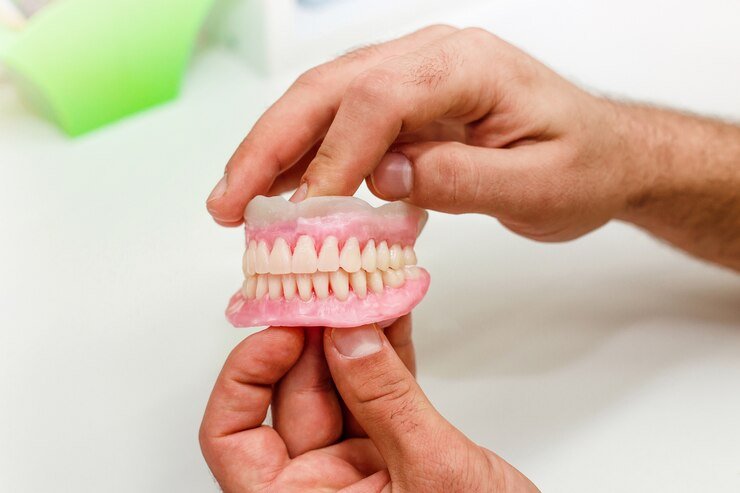
* Patients can care for dental implants, by using yarn instead of floss.
*Alternately, dental assistants
can suggest that patients should visit the dental office for cleaning implants
with plastic scalars, which help to clean implants and remove calculus.
*Similarly, dentures can be
cleaned by using a specially designed larger brush and toothpaste. In addition,
there are several commercial denture cleansers that help eliminate stains and
prevent bad breath. Dentures as well as partial dentures can be immersed in
these solutions.
*Alternatively, patients can also
use a solution of warm water and vinegar, to clean calculus from dentures.
*Orthodontic appliances and
prosthetics can be cleaned with specially designed orthodontic toothbrushes,
which are able to clean inter-dental areas.
Fact
without natural teethElderly adults without natural
(edentulous) teeth have dropped from 30% in 1978 to 6% in 2009.
Source: British Dental Journal
2011
Activity 2
Estimated time: 10 minutes
What daily dental care regimen
would you like to suggest to patients that they should follow at home?
Module Summary
Just as in other fields,
professionals in the dental field use specific and special terminology during
communication. Familiarising yourself with important dental jargon will help to
enhance your ability to interpret and understand instructions and information
correctly. Learning important dental terms is critical, in order to become
successful in your career.
Brushing teeth is a repetitive
and seemingly mundane activity, which most of us religiously perform twice a
day. However, most people may not be familiar with the correct brushing
techniques. Incorrect or inadequate brushing results in accumulation of plaque
and increased risk of tooth decay and periodontal disease. In fact, research
indicates that bacteria from the mouth eventually finds its way into the
bloodstream and increases the risk of stroke and heart disease. In addition,
you may need to brush a set of teeth that have been fitted with dental
prosthetics. Dental assistants should explain the correct methods of brushing
teeth to different patients.
There are several ways to brush
the teeth, including vibratory, circulatory and scrub brushing methods. The
important point is to ensure that you advise the patients to spend at least 50
seconds brushing each individual quadrant of the mouth. The bristles should be pressed
gently against tooth and biting surfaces and moved in the recommended ways. The
patient should be advised to brush the outside as well as inside of the teeth.
In addition to regular twice a day brushing, flossing is crucial for the
removal of plaque and keeping gum disease at bay.
.svg)